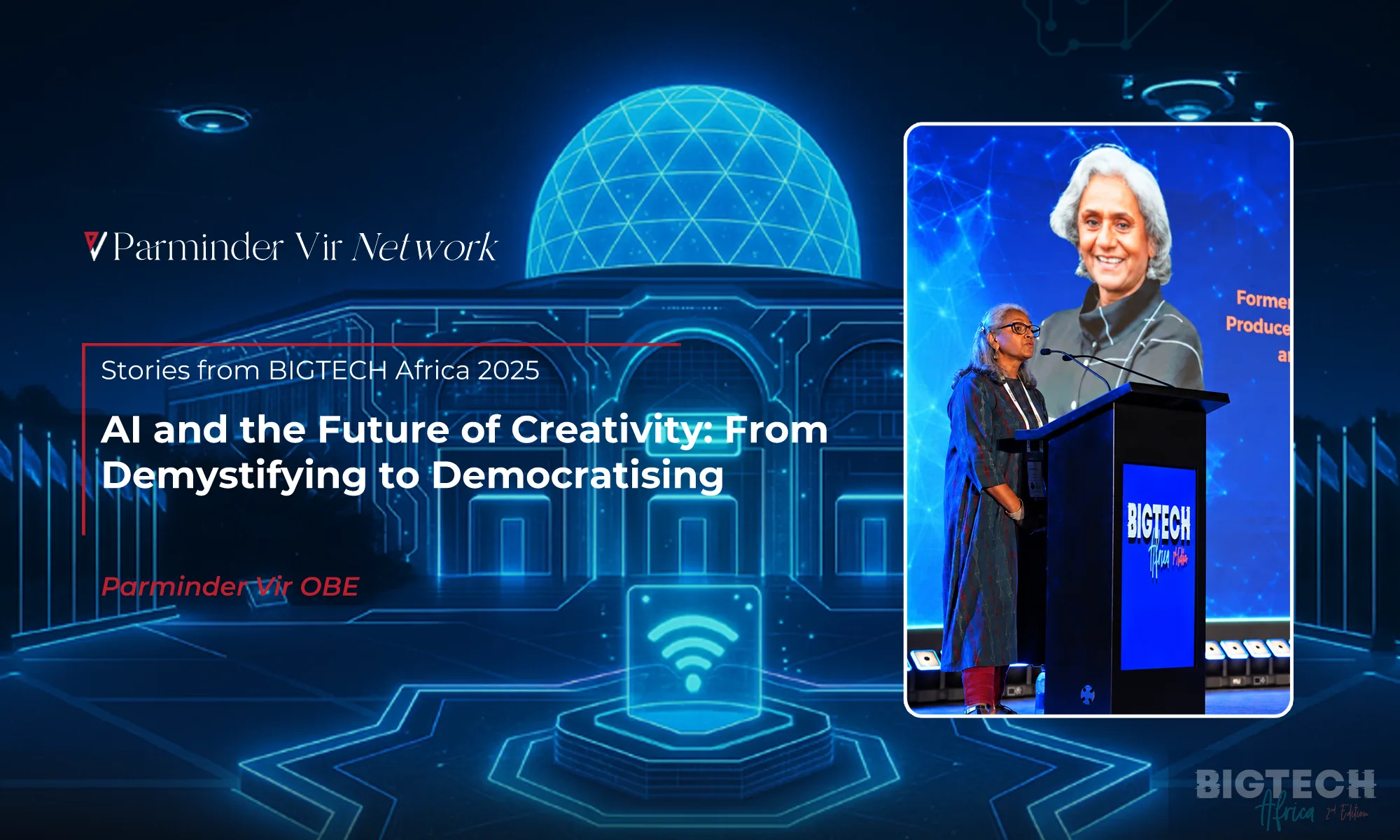
This is the sixth and final essay in my reflections following BIGTECH Africa 2025 in Tunisia.
Throughout the Summit, I explored the opportunities and challenges presented by technology, entrepreneurship and innovation. My closing keynote turned to perhaps the defining question of our age: Artificial Intelligence.
There is no shortage of discussion about what AI can do. My concern is different. How do we ensure that AI expands, rather than narrows, human creativity? How do we ensure that the next creative revolution is not controlled by the few but opens new opportunities for the many?
These questions are deeply personal. They connect directly to my own journey over four decades—from championing Black and Asian artists at the Greater London Council, to producing films, supporting African entrepreneurs, and now reflecting on how AI may reshape the future of storytelling itself.
A New Creative Revolution
Artificial Intelligence is not creeping into the creative industries — it is racing in. By 2026, over 90% of all online content is expected to be AI-generated (World Economic Forum). The creative economy, worth trillions globally, now faces a transformation more radical than the arrival of sound in cinema or the digital revolution of the 1990s.
The question is no longer whether AI will change creativity. It already has. The urgent question is: does AI expand human creativity, or does it risk replacing it?
AI and Creativity in Numbers
The numbers tell their own story:
- $1.5 trillion — the potential value AI could add to the global creative economy by 2030 (PwC).
- 40% of creative professionals already use generative AI tools in their daily work (Adobe, 2024).
- On YouTube, AI-generated music videos attracted 1.7 billion views in 2024 alone.
- McKinsey projects AI could automate up to 30% of tasks in film production — from script drafts to visual effects.
These figures show both scale and disruption. Creativity is no longer the exclusive domain of trained specialists or deep-pocketed studios. AI is dissolving the old hierarchies.
A Filmmaker’s Journey
I began my career with stories told through film, where every frame was fought for with time, money, and collaboration. Producing Babymother in 1997 required full crews, cameras, film stock, editors, and weeks in the cutting room. Every decision was a logistical battle.
Today, a young filmmaker with a laptop and an AI model can generate a storyboard, experiment with visuals, and compose a score in a matter of hours. What once required an army now sits on a single screen.
This is thrilling and unsettling in equal measure. I see echoes of my own struggles as a producer — negotiating access, fighting for representation, amplifying unheard voices. Yet I also see new possibilities: tools that lower barriers, democratise access, and allow those same unheard voices to create with power and speed.
Looking back, I realised that the thread running through my career has never simply been technology or film. It has been the belief that creativity flourishes when access expands. In the 1980s, that meant demystifying filmmaking and democratising opportunities for Black and minority ethnic filmmakers. Today, AI presents the same challenge on a global scale. The tools are different. The principle remains the same.
The New Creative Paradigm
AI is not just a tool — it is becoming a collaborator, sometimes even a challenger. Studios like Vision Machina, a generative AI cinematic production house in Southeast Asia, embody this new paradigm. Its mission is bold: to blend seasoned storytellers and AI into a creative studio producing genre-defying, emotionally resonant films. This is not about replacing the filmmaker, but about extending the boundaries of what cinema can be.
In Nigeria, Obinna Okerekeocha’s Naija Artificial Intelligence Film Festival (NAIFF) is charting a parallel path. NAIFF champions a new generation of African filmmakers who use AI not as a shortcut, but as a lens to push cinematic storytelling into new, uncharted territory. It celebrates innovation, creativity, and the limitless possibilities of AI-powered filmmaking.
As Professor Julian Henriques often reminds me, stories are how we make sense of the world. They help us connect events, understand people and imagine different futures. Technology, whether the paintbrush, the camera, or the algorithm, changes how stories are made and shared, but not why they matter.
Here lies both the risk and the opportunity. The risk is homogenisation, as AI systems trained on narrow datasets reproduce the same clichés and erase the margins. The opportunity is radical inclusivity: to expand genres, traditions, and perspectives, and to amplify voices long excluded from dominant narratives.
The paradigm is clear: AI will not replace human creativity. But human imagination, harnessing AI, can expand the narrative universe beyond what we have yet imagined. Crucially, the examples of Vision Machina and NAIFF show that the Global South is not waiting to be invited into this future; it is already shaping it. These initiatives embody the potential of AI to break open old hierarchies and create space for new voices on the world stage.
From Demystifying to Democratising
This continuity excites me. In the 1980s, my work at the Greater London Council was about demystifying the process of filmmaking. Through exhibitions, workshops, and grants, I curated and championed the works of filmmakers from what was then called the “Third World.” The aim was simple but radical: to democratise access, so Black and ethnic minority filmmakers could tell their own stories on their own terms. Funding, training, and visibility were the tools we used to crack open an exclusionary system.
That mission has guided me ever since. From 1986 onwards, I carried it into film production, supporting independent voices, and later into the wider world of African entrepreneurship. Across these decades, one principle has endured: creativity flourishes when barriers are removed, when the means of production are not hoarded by the few but placed in the hands of the many.
This is why I am excited by AI and its implications for the Global South. For the first time in history, a filmmaker in Lagos, Nairobi, or Dhaka can access powerful storytelling tools without needing Hollywood- or Pinewood-grade infrastructure. AI has the potential to collapse the old asymmetries of capital, distribution, and geography. It can empower a new generation of creators to leapfrog the historical exclusions of the global media industries.
But this is not automatic. If AI tools are primarily trained on Western datasets, the risk is that the Global South becomes a consumer, rather than a creator, of machine-generated culture. The challenge and the opportunity are to embed African, Asian, and Latin American stories, languages, and aesthetics into the very DNA of AI systems.
Just as we fought in the 1980s for space, funding, and recognition, we must fight for representation in algorithms today. If we succeed, AI could become the most powerful equaliser the creative industries have ever known, amplifying the brilliance, resilience, and originality of the Global South on the world stage.
And this fight is not just for the Global South. It is about redefining creativity itself. From cave paintings to Bollywood, Nollywood, and Hollywood, every generation has experienced its own storytelling revolution. AI is this generation’s revolution. The challenge is to ensure it serves not just profit or platforms, but people, enabling new stories from Africa, Asia, Latin America, and beyond to shape the global imagination.
My own journey, from championing Black and Asian arts at the Greater London Council, to producing films that amplified unheard voices, to supporting African entrepreneurs in the digital age, has taught me one lesson: technology only matters if it serves human creativity and human potential.
Creativity has always depended on human imagination. Tools, such as the brush, the camera, and the edit suite, extend its reach, but they do not replace it. AI is simply the latest, and perhaps the most powerful, of these tools.
The question we must ask is not, “What can AI do?” The real question is: who holds the brush, whose hands guide the camera, and whose stories get painted across the canvas of the future?
Parminder Vir OBE
Ambassador, India-Africa Tech & Startup Bridge: BIGTECH Africa 2026
Entrepreneurship Expert, Oxford Saïd Entrepreneurship Centre
Former CEO, Tony Elumelu Foundation