Behind every startup that changes an industry is an investor willing to take a risk. At BIGTECH Africa in Tunis, I met investors who see not only the promise of profit but the possibility of reshaping Africa’s future. These are not mere financiers scanning spreadsheets for the next big return; they are long-term partners whose bets may define the trajectory of artificial intelligence and technology on the continent.
Africa is not short of ambition. Young founders are building companies to solve problems of scale in finance, logistics, health, education, and climate. What they often lack is the bridge between vision and viability: capital that understands the context, and investors who bring more than money. In Tunis, I listened to conversations that revealed how the best investors in Africa are positioning themselves as partners, mentors, connectors, and, in many ways, architects of the ecosystem itself.
Here, I want to share the perspectives of two African investors I met at BIGTECH Africa. Idris Ayodeji Bello, Managing Partner at LoftyInc Capital, and Gbite Oduneye, Managing Partner of ODBA, a Nigerian investor based in London.
LoftyInc Capital
From Voice to Vision: The Builder’s Creed
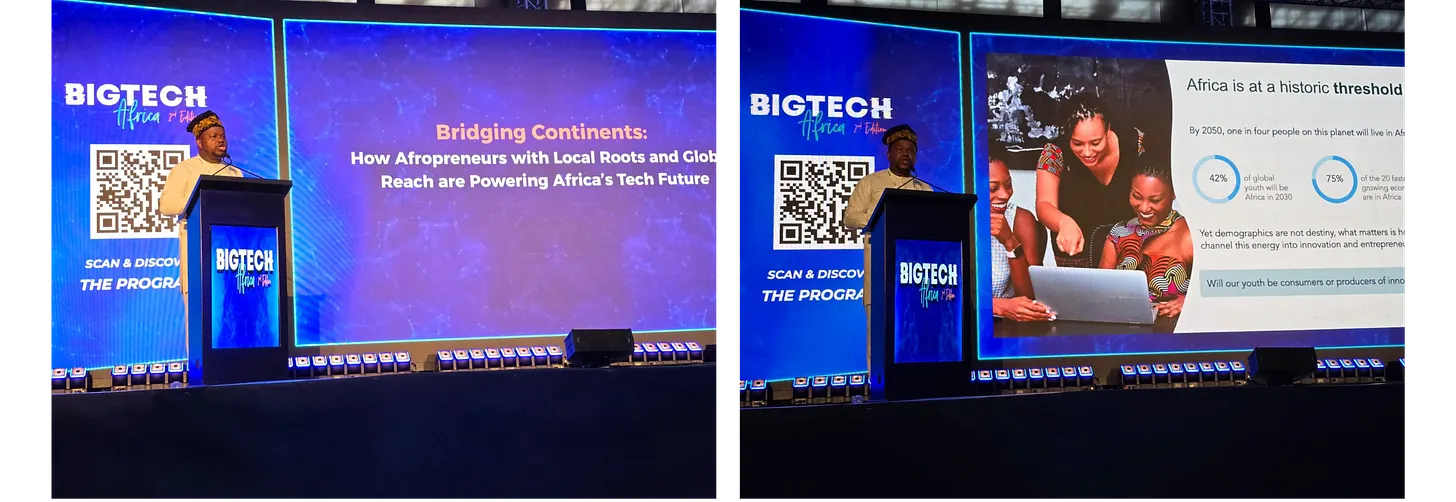
One of the most powerful moments came during Idris Ayodeji Bello’s address, Bridging Continents: How Afropreneurs with Local Roots and Global Reach are Powering Africa’s Tech Future. His booming voice filled the hall as he declared:
“Africa stands at the threshold of history. With its youth, creativity, and resilience, the continent is fast becoming the world’s next engine of innovation.”
It was more than rhetoric. Bello’s journey with LoftyInc Capital illustrates what it means for an investor also to be a builder of ecosystems. His firm has backed more than 160 startups across fintech, healthtech, climate-tech, and more. From this portfolio, four unicorns have already emerged. Those unicorns were not outliers—they were signals that African innovation, when supported by long-term capital, can achieve global scale. The lesson, as he told the Tunis audience, is that African founders are transforming not just their own markets but the global narrative of entrepreneurship.
From Capital Providers to Ecosystem Builders
Bello coined the term Afropreneurs to describe these founders: resilient, bold, and rooted in local realities while reaching for global markets. To support them, LoftyInc didn’t just provide checks; it built angel networks, incubators, and cross-border platforms. As Bello emphasised, the challenge is not simply starting companies, but scaling them — and that requires bridging Africa with global pools of capital.
He also highlighted Tunisia’s rising role in this story — as a hub of talent and creativity, and home to Smart Capital, one of LoftyInc’s key partners. He credited Smart Capital’s catalytic role in showing how local investors can unlock global opportunities. This was a reminder that building Africa’s ecosystem is not about isolated markets but about corridors of collaboration, where regional and global capital work together to unlock scale.
Listening to Idris, I recognised the same belief that shaped my work with the Tony Elumelu Foundation—capital is never enough; ecosystems make entrepreneurship real. The Afropreneurs he champions are rewriting the rules, showing how local ingenuity, backed by African and global capital and connected ecosystems, can build companies that stand shoulder to shoulder with global peers.
Artificial intelligence was a constant thread in Tunis. Bello connected it to the broader theme: Africa’s youthful population and creative energy make it fertile ground for AI-driven innovation. Yet he was clear-eyed about the challenges: fragmented markets, limited datasets, uneven infrastructure. That is why investors matter. Their choices will decide whether Africa becomes a consumer of imported tools or a creator of its own IP.
Investors like Bello see AI not as an abstract risk but as a practical tool for solving pressing problems: credit scoring, where traditional records are lacking, diagnostics, where doctors are scarce, and logistics, where roads are poor. This pragmatic approach, rooted in solving real problems for millions, is what makes Africa’s AI journey distinctive.
The success stories speak for themselves. Flutterwave scaled to become a payments powerhouse. Andela redefined how African software talent could compete globally. Reliance Health built a model for affordable, sustainable care. These were not accidents of luck; they were outcomes of a model that combines capital with scaffolding — mentorship, networks, regulatory navigation, and follow-on funding.
This model works because it matches Africa’s reality. Startups here cannot rely on predictable venture pipelines or frictionless exits. They need patient investors who are also ecosystem architects — willing to walk with them through regulatory complexity, infrastructure gaps, and the painstaking work of scaling city by city.
ODBA
The Pragmatist’s Eye: Investing in Proof
The Pragmatist’s Eye: Investing in Proof
Where some investors speak in sweeping visions, Gbite Oduneye, Managing Partner of ODBA, finds clarity in discipline. Smart, sharp, and no-nonsense, Gbite embodies a new generation of African venture capital: globally connected, deeply knowledgeable, and uncompromising in his passion for the continent’s entrepreneurs. His presentation at BIGTECH Africa was refreshingly direct:
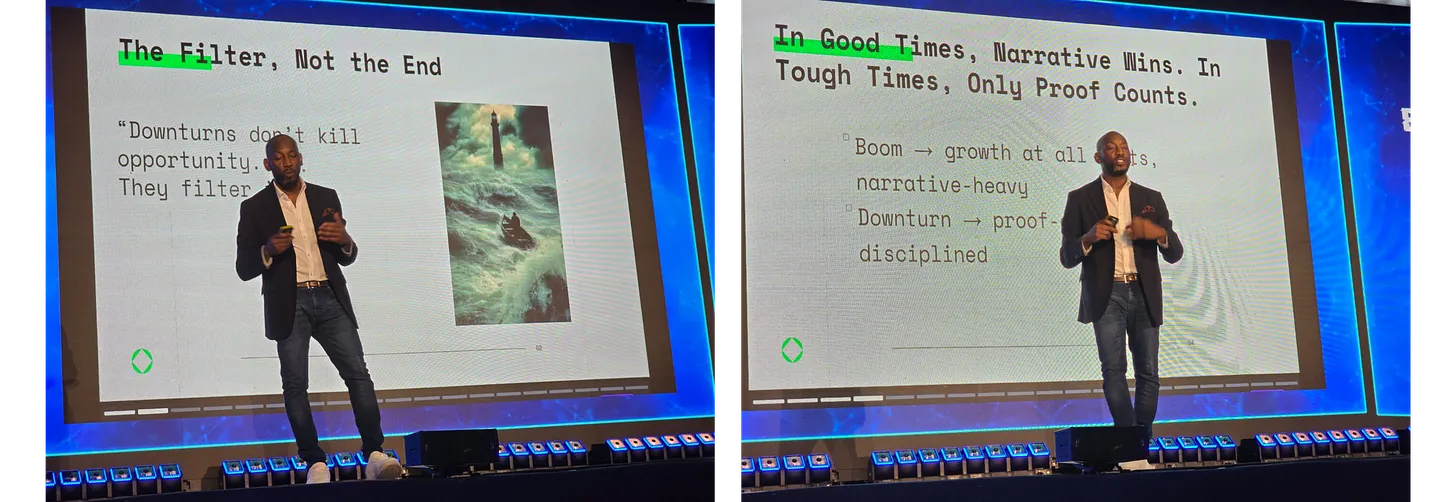
“Tough markets don’t kill opportunity. They filter it. What remains is fundable.”
That single line captured his philosophy. In an environment where capital is scarce, valuations compressed, and investors cautious, Gbite insists that founders must prove substance over style. At ODBA, the filters are clear:
- Traction before narrative
- Burn multiple before vanity growth
- Governance before charisma
- Proof before vision
This is not cynicism; it is discipline forged in the realities of African markets. For Gbite, resilience and proof are not optional extras — they are the very foundation of fundable companies.
ODBA describes itself as backing extraordinary founders who use technology to reshape the world. But behind the words lies a philosophy that Gbite articulates with conviction:
We invest in people, not just ventures. We invest in passion, not performance theatre. We invest anywhere, because regions without problems are regions without entrepreneurs.
With dual bases in London and Delaware, ODBA has global reach, but its beating heart is in Africa. For Gbite, the continent’s youth and creativity are a competitive edge. What matters is finding those who can combine local insight with the governance, resilience, and proof that global investors demand.
Lessons From the Portfolio
Gbite grounds his principles in practice. At Tunis, he walked us through ODBA’s portfolio, each example a lesson in his investment philosophy.
- Kuda, the Nigerian digital bank, showed that governance and solid economics could carry a startup to a $500 million valuation.
- Treepz, a mobility company, stumbled mid-cycle but rebuilt itself stronger, proving that resilience can turn setbacks into comebacks.
- Awabah, tackling pension access for informal workers, shows that inclusive fintech can build both social impact and commercial value.
- Kunda Kids, a children’s media company, proves how African stories can shape global culture and build brands that matter across borders.
Each story illustrates Gbite’s filters in action: traction, resilience, governance, and proof. These are not abstract metrics; they are lived realities for founders navigating tough markets.
One of the sharpest moments of Gbite’s Tunis talk addressed the hard truth of today’s venture landscape. Global capital is cautious, African valuations are compressed, and the easy money of earlier cycles has dried up. For many founders, this feels like a crisis. For Gbite, it is a reset— a return to fundamentals.
Show traction before you spin the narrative. Prove your burn multiple before boasting of growth. Put governance before charisma. Deliver proof before painting the vision.
Companies that internalise these lessons emerge stronger and more investable. Those that don’t, fade. The market itself becomes the ultimate filter.
A Conversation Across Generations
I had first encountered Gbite’s work long before we met in person. Unknown to me, he had followed my journey as CEO of the Tony Elumelu Foundation (TEF). Back in 2017, he sat in the vast auditorium of the TEF Forum, where over 2,500 entrepreneurs gathered for Africa’s largest entrepreneurship event. He told me later that he had felt the pulse of Africa in that room. When we finally met at the Afribond event in London in 2024, and again at BIGTECH Africa in Tunis, our conversations flowed naturally — long, intense exchanges about Africa, startups, their challenges, and the opportunities ahead.
Our conversations went beyond capital to the meaning of impact. Gbite’s reflections reminded me that ecosystem building is cumulative: my work at TEF may have laid foundations; his generation is now raising the next level.
Looking Ahead
Gbite Oduneye represents the pragmatist’s eye in Africa’s investor landscape. Where Idris Bello speaks of Afropreneurs rewriting history, Gbite insists on governance and proof as the bedrock of scale. Both are essential: vision and discipline, optimism and pragmatism.
For Africa’s entrepreneurs, these investors are not distant financiers. They are partners who ask the tough questions, filter the noise, and help shape companies that can survive scarcity and thrive in abundance.
The challenge now is scale. As more international capital flows into Africa, the temptation to chase quick returns grows. But the investors I met in Tunis — Bello and Gbite among them — know that Africa’s ecosystem must be built for the long haul. It is not a quarterly project but a generational one.
The true measure of success will be when African investors back African founders at every stage, and when those founders in turn reinvest in the next generation. Already, LoftyInc’s portfolio companies are becoming mentors and investors themselves, multiplying the impact of the original bets.
Behind every thriving startup is someone willing not just to invest money but to believe. Bello’s words still echo: Africa stands at the threshold of history. The future will belong to those willing to build it together.
Parminder Vir OBE
Ambassador, India-Africa Tech & Startup Bridge: BIGTECH Africa 2026
Entrepreneurship Expert, Oxford Saïd Entrepreneurship Centre
Former CEO, Tony Elumelu Foundation