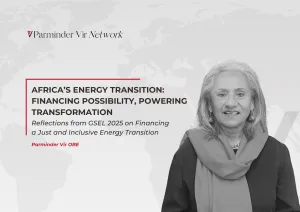
Reflections from GSEL 2025 on Financing a Just and Inclusive Energy Transition
The Journey
It took me one hour and thirty minutes to reach the University of East London’s Docklands Campus — tube, then DLR, ending at a station called Cyprus. I paused at the name. Why Cyprus? Why here? As the doors opened, students of African and Indian descent poured out of the carriages.
I stopped one young man to ask for directions.
“Follow me,” he said, in the broadest Indian accent, instantly transporting me back to India, where I had just spent two months soaking in the monsoon. He was from Hyderabad, studying computer engineering, hoping to find a job, a partner, and build a life in the UK.
Walking through UEL’s shining glass buildings, it became clear why so many students from Africa and India choose this campus. It is one of London’s most diverse universities — nearly 70% of its students identify as Black, Asian, or of dual heritage — and its Docklands campus, opened in 1999, has become a destination for international postgraduate students. Several told me that they chose UEL because it is “affordable,” with annual fees ranging from £15,000 to £18,000. The university’s ethos of widening access and offering a career-first education is palpable from the moment you enter.

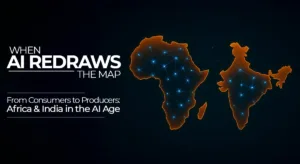
This was the fitting backdrop for the Global Sustainable Education and Leadership Network (GSEL) Conference 2025, a gathering exploring The Intersection of Innovation, Sustainability, and Equity for Energy Access. Convenor, Joy Osomiamhe-O, shared GSEL’s foundation on three principles: Education, Energy, and Environment. Their vision resonated with my commitment to entrepreneurship as the engine of Africa’s social and economic advancement.
So I welcomed the invitation to chair a critical conversation on Financing Africa’s Energy Transition and explore how we mobilise more capital, faster, and more fairly – so innovation and inclusion move together.
And what a conversation it was.
Setting the Stage
I opened the session by grounding us in the stark numbers:
- 600 million people in Africa remain without electricity.
- 900 million people still cook without clean energy.
- Without accelerated investment, innovation, and enabling policies, these numbers will not shift by 2030.
For me, this discussion is deeply personal. In my role as CEO of the Tony Elumelu Foundation and Advisory Board Member (2014-2021), I helped design and implement a comprehensive entrepreneurship programme, supporting thousands of entrepreneurs — including innovators working on clean cooking, solar home systems, mini-grids, and climate technology solutions. Over the decade of this engagement, I have seen firsthand how access to energy, skills, markets, and capital transforms not just businesses, but entire communities and futures.
This panel reminded me of that truth again.
Panellist Insights

1. Krista Tukiainen — ClimateAligned
Krista leads ClimateAligned, a pioneering climate fintech platform that uses advanced data analytics and AI to help investors assess climate risk and make informed investment decisions. With her background in environmental economics and her experience shaping global green-investment standards at the Climate Bonds Initiative, she offered critical insights.
I asked her how analytics and digital platforms can build investor confidence in smaller, decentralised, women-led, and community energy enterprises, especially in Africa’s fragile economies. Her response was clear:
-
- Africa doesn’t lack entrepreneurial creativity — it lacks investment-grade data, structured climate intelligence, and transparent risk frameworks.
- Climate fintech can close that gap by helping investors understand real risk, not imagined risk.
- Financial tools must evolve to make small, decentralised projects genuinely bankable.
Krista reminded us that the future of climate finance is not only about capital — it is about information that builds trust.
2. Marianne Klarsfeld — European Bank for Reconstruction and Development (EBRD)
Marianne brought the multilateral development perspective, grounded in her work financing sustainable infrastructure across the Middle East, North Africa, and Eurasia.
Marianne was refreshingly candid about the deep structural barriers DFIs face:
-
- Currency volatility is one of the biggest barriers to financing energy access.
- Grant funding alone cannot unlock scale; it must be paired with smart procurement and active private-sector participation.
- EBRD’s work has historically focused on North Africa, but the bank is now shifting toward Sub-Saharan Africa, particularly West Africa.
I reflected that EBRD’s green transition experience in Egypt, Morocco, and Algeria carries lessons that could be powerfully adapted to the realities of West African markets. She agreed, emphasising that the institution is evolving — and must continue to evolve — to meet Africa’s needs.
3. Ray Coyle — Energise Africa
Ray leads Energise Africa, a UK-based investment platform that connects individual retail investors with African clean-energy SMEs through debt financing. Several things stood out:
-
- Energise Africa already has 5,000 registered investors.
- Returns range from 6% to 8%, a lifeline compared to the 25–30% interest rates entrepreneurs face from local banks.
- They are actively exploring how to mobilise the African diaspora, an untapped pool of capital with emotional attachment and investment appetite.
In a climate-finance landscape dominated by institutional capital, Energise Africa is building the infrastructure for ordinary people to invest in Africa’s energy transformation. It is a democratisation of capital that Africa desperately needs.
4. Kayode Tinuoye — Genesis Energy
Kayode is a seasoned African project-finance expert who has worked across capital markets, investment banking, and energy infrastructure. Now at Genesis Energy, he finances power projects across the continent. Kayode, a former colleague from my TEF days, grounded the conversation in reality:
-
- Many investors misunderstand African markets — risk perception is often a function of limited local knowledge, not actual risk.
- Building domestic capital pools is essential. Africa cannot rely exclusively on external financing.
- Africa cannot industrialise using clean energy alone — we must take a full energy value chain view, including transitional fuels and the critical role of transmission and distribution infrastructure.
We agreed that much of the global narrative about Africa is wrong. Across the continent, countless African innovators are advancing clean-energy solutions, but they need finance that understands their context, not one imported wholesale from Europe.
Kayode’s message was clear: a just transition must be contextual, not imported.
Emerging Themes
Across the panel, several themes resonated:
- The energy transition must be equitable — or it will fail.
Women, rural communities, SMEs, and fragile economies must be central to the solution. - Blended finance is the bridge — but the bridge is incomplete.
We urgently need better risk-sharing, local-currency instruments, and domestic capital mobilisation. - Africa’s transition will follow its own path.
Industrialisation requires reliable baseload power and pragmatic energy mixes, not a copy-and-paste from Europe. - Data is becoming as valuable as capital itself.
Without climate-intelligent insights, investors will continue to overestimate risk and underinvest in opportunity.
Closing Reflection
As I left the Docklands campus, watching students cross the bridge over Royal Albert Dock, I thought about the very people these conversations are ultimately for: young Africans and Indians preparing themselves for a new world — one shaped by climate, technology, and entrepreneurship.
Financing the transition is not just about the flow of money.
It is about the flow of possibility.
It is about building systems that recognise talent, trust local innovation, and unlock the capital required for transformation.
GSEL 2025 made that abundantly clear: When capital meets imagination — change happens.
Thank you, Joy Osomiamhe-O, and the G-SEL Network, for the invitation to participate, contribute and learn.